From Share to Payout: Tracing a Block Through the Pool
A share is not a coin, and a block is not a payment. A 1000 TH/s machine submits shares continuously, the pool turns them into a claim on blocks, and blocks become spendable balance only after they exist, propagate and reach 6 confirmations — about an hour at today's 10-minute block spacing. The end point is 0.00047353 BTC a day at 132.76 T difficulty, $40.39 gross and $38.77 after the listed 4% block-reward fee.

Key takeaways
- Shares are accounting units: at 1000 TH/s they accrue 0.00001973 BTC an hour under PPS+ settlement, which is about $1.68.
- Blocks are probabilistic: the same 1000 TH/s is 1 in 950,300 of network hashrate, so it would wait roughly 6,600 days for a block of its own without a pool.
- Confirmations are the gate. PPLNS pays after 6 confirmations, roughly 60 minutes behind the block, over the last 5 difficulty rounds.
- Fees attach to components, not to the balance: a listed 4% on the PPS-settled block reward and a listed 2% on transaction fees, or a listed 2% on both under PPLNS.
The path a share takes
Start at the machine. A miner hashes block headers, and every time the result beats a target set by the pool it sends that solution as a share. The pool verifies it against the job it handed out, then records it in the account for the worker that submitted it. This step takes seconds and is independent of whether a block is ever found — which is why a hashrate graph and a share graph should match, and why a mismatch is the first sign of a worker fault.
The next step is the pool's problem, not yours. The pool assembles candidate blocks from the same header stream and broadcasts any block that meets the network target of the current 132.76 T difficulty. Across the network that happens 144 times a day, splitting 450 BTC of issuance between every participant. The pool's own block count follows its share of hashrate plus Pool Luck, which is the rolling difference between blocks found and blocks expected.
A block is a candidate until it is buried. Six confirmations is roughly an hour at 10-minute spacing, and it is the point at which the chain has almost certainly settled around that block. Everything downstream of that — credits, balances, withdrawals — inherits the delay, which is why a block found during a quiet period can take an hour to appear in a payout record.
What the pool does with a block
Once a block is confirmed, the reward is split and settled according to the payout mode. Under PPS+ the block-reward component is paid on a PPS basis, at a listed 4%, and settlement happens every hour at current difficulty — so your balance moves in 24 steps a day whether the pool found zero blocks or thirty. The transaction-fee component follows PPLNS logic at a listed 2%, because fees arrive with blocks and are distributed with them.
Under PPLNS the block reward and the transaction fees are handled together at a listed 2%, and the payment goes to miners in proportion to their shares in the last 5 difficulty rounds — about 10,080 network blocks, roughly 70 days. Same block, same confirmations, different weighting rule. This is also where Pool Hashrate matters twice: the pool's figure determines how often blocks appear, and your figure determines what fraction of the window's shares is yours.
| Stage | What happens | Clock or figure |
|---|---|---|
| Share submitted | Worker sends a solution that beats the pool's target; pool verifies and records it against the worker | Seconds; continuous while the machine hashes |
| Block found | Pool broadcasts a solution beating the network target at 132.76 T difficulty | 144 blocks a day network-wide; 1000 TH/s is 1 in 950,300 |
| Confirmed | Six blocks bury the block; the reward becomes effectively final | About 60 minutes at 10-minute spacing |
| Settled | PPS+ credits hourly at current difficulty; PPLNS distributes over the last 5 rounds | 0.00001973 BTC per hour, about $1.68, against roughly 70 days for the PPLNS window |
| Withdrawn | Balance is paid out from the account, with zero-fee mining payouts | Whatever the payout threshold in your account requires |
| Converted | Income can be converted across supported coins in the same account | 20+ supported coins, including BTC, BCH, LTC with merged DOGE, KAS, ZEC, HNS, CKB and ETC |
The table is the honest timeline. Two of its six rows are measured in seconds and one is measured in weeks, which is why miners who watch balances rather than shares tend to misread their own performance.
Worked example
Trace 1000 TH/s through the whole chain at the readings of 22 Sept 2026. Hashrate share: 1,000,000,000,000,000 hashes per second against a network hashrate of 950.3 EH/s is 0.00010523%, or 1 in 950,300. Gross daily output: 450 BTC of daily issuance multiplied by that share gives 0.00047353 BTC, which is $40.39 at $85,294.
Apply the listed fee: 96% of $40.39 is $38.77, or 0.00045459 BTC. Break it down further and the hourly credit is 0.00001973 BTC, about $1.68, which is also the value of one hour of downtime. Without a pool the same hashrate would be waiting for its own block: 950,300 divided by 144 blocks a day is about 6,600 days, or roughly 18 years, for a single 3.125 BTC subsidy plus fees — the arithmetic that explains why shares exist as an accounting layer at all.
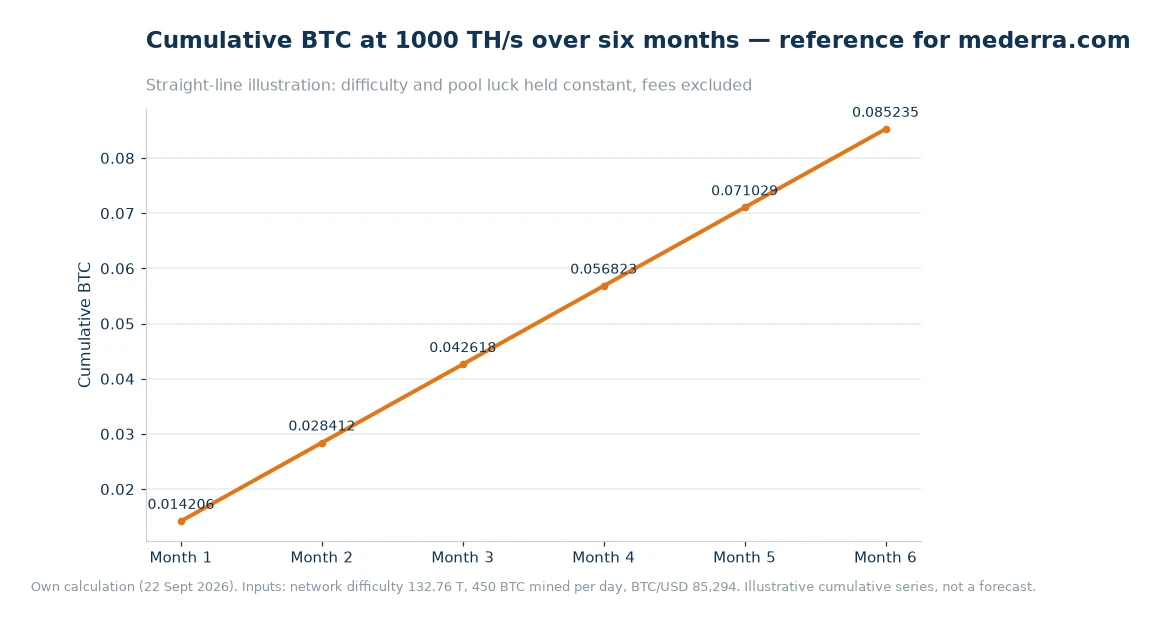
Month one of that series is 0.014206 BTC, about $1,211.68, and month six closes at 0.085235 BTC, roughly $7,270. The flat slope is the share-to-payout chain working exactly as designed; the reason a real balance chart is bumpier is that difficulty moves, luck moves and uptime is never perfect.
Tracing it on your own account
You can verify each stage from the account side. Your share count per worker should track your delivered hashrate, the pool's block count should track ViaBTC Pool Hashrate plus luck, and your credit history should show either hourly steps or block-shaped steps depending on your payout mode. Discrepancies almost always sit in the first of those three.
Two other pages make the trace easier to follow. The pool statistics dashboard shows the network and pool series side by side, and the multi-currency wallet shows where the balance sits once settlement has happened, including whether an incoming payment is still confirming.
Frequently asked questions
Why did my hashrate rise but my balance not move?
Because shares and payments run on different clocks. Shares are recorded in seconds, PPS+ credits hourly at current difficulty, and PPLNS waits for 6 confirmations before distributing each block across the last 5 difficulty rounds.
Do all my workers need to be correct for me to be paid?
No. Each worker's shares are recorded separately, so a single misconfigured machine loses only its own hashrate — at 132.76 T difficulty, one idle 100 TH/s rig costs about $4.04 a day of gross income.
Is a share worth the same as a fraction of a block?
In expectation, yes, once the fee is applied. A share is a probability claim: shares accumulate until the pool finds a block, and then the block value is distributed across them according to the payout mode.
Where the trace usually breaks
Three things break the chain between share and payout in practice. A worker pointed at a stale or wrong pool address keeps hashing and stops recording shares. A difficulty change moves the value of every future share, so a balance compared with last month's is not a like-for-like comparison. And a payout mode change resets the calendar, because the window restarts differently under PPLNS than under hourly settlement. Check the share count first, then the mode, then the note about fees on the components, and keep a weekly record of delivered hashrate next to credited income so the gap between the two explains itself before it becomes a support ticket.
Data and sources: ViaBTC listed fee schedule and payout rules[1], the statistics dashboard[2] and the multi-currency wallet page[3]. Difficulty (132.76 T), network hashrate (950.3 EH/s), the 3.125 BTC subsidy, 144 blocks a day and a BTC price of $85,294 come from public chain data and market feeds, read 22 Sept 2026. Figures are arithmetic on those inputs, vary with difficulty and price, and are not a promise of earnings.