Quality Control Checkpoints in Premium Fragrance Production
Premium fragrance production is not a different process from ordinary fragrance production; it is the same process with tighter criteria and better evidence at every checkpoint. The practical consequence for a brand is that quality is negotiated at the specification stage, checkpoint by checkpoint, rather than inspected at the end. A supplier who cannot state the acceptance criteria for a checkpoint cannot be held to them later.
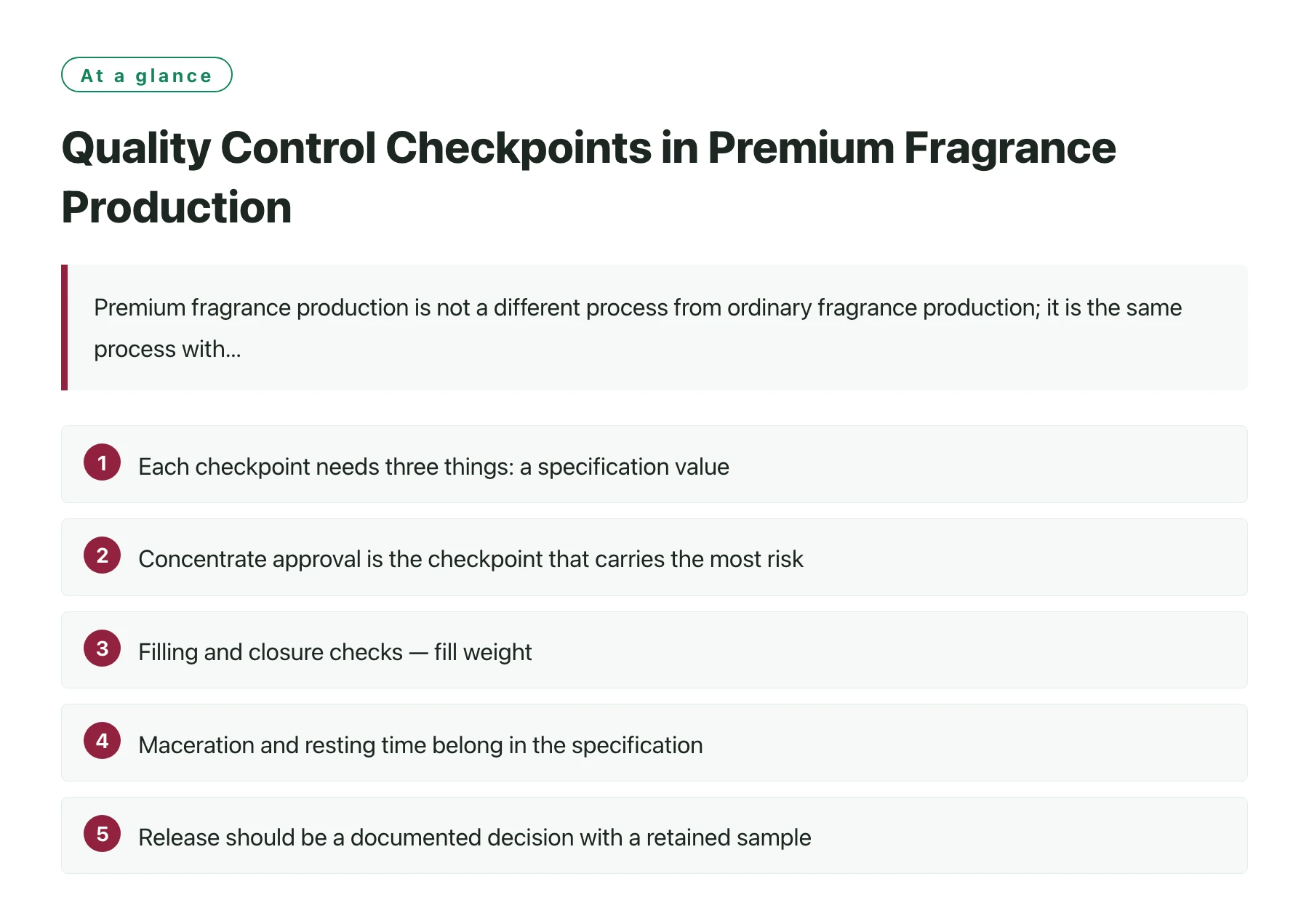
Key takeaways
- Each checkpoint needs three things: a specification value, a method for checking it, and a record that shows the check took place.
- Concentrate approval is the checkpoint that carries the most risk, because it fixes the allergen declaration, the restricted-material position and the reference standard for the whole run.
- Filling and closure checks — fill weight, crimp, leak and spray function — are the ones a customer notices immediately when they fail.
- Maceration and resting time belong in the specification; treating them as optional is what makes two batches from the same formula smell different.
- Release should be a documented decision with a retained sample, not the moment the last pallet is wrapped.
Buyers of high-end fragrance often ask for something called premium quality control, and suppliers often answer with a certificate list. Neither the question nor the answer is specific enough to be useful.
The workable version of the question is: at which points in the process will the product be checked, what value will it be checked against, and what record will prove it. That converts a vague expectation into a set of acceptance criteria that both sides can work to.
This is a walk through the checkpoints in a premium fragrance project, written from the position of a brand's technical manager who has to defend the release decision to a retail partner. The sequence follows the product, from incoming materials to the retained sample.
Checkpoint one: incoming materials
Everything downstream depends on what arrives at the door. For a premium product the incoming check covers identity, purity, documentation and — for the fragrance concentrate — the declaration content that will eventually appear on the label.
The value of this checkpoint is traceability. A batch that cannot be traced to specific incoming lots cannot be investigated if something goes wrong later, and investigations that cannot narrow the cause tend to end in a full recall of the run rather than a targeted one.
What the specification should state
For the concentrate: supplier, reference code, version date, allergen declaration and a statement of the material restrictions that apply to the intended product category, because those limits depend on how the product is used and at what concentration [1]. For the packaging: dimensions, colour reference, material and the tolerances that will be accepted.
For anything applied to skin, the ingredient declaration that will go on the label is built from standard ingredient names, and the EU's CosIng database is the reference list most export markets work from when checking those names and their declared functions [2]. Agreeing the naming early avoids a late change to artwork.
Checkpoint two: concentrate approval
This is the checkpoint that fixes the most. Approving a concentrate approves the scent, the declaration, the restricted-material position and the reference against which every later batch will be judged.
It should produce a sealed, dated retained sample held by both parties, and the reference should be recorded with the version of the formula it corresponds to. Approvals that exist only as a photograph or an email comment are the reason sample-versus-bulk disputes are so common.
The dilution the concentrate will be used at belongs in the same decision. The same base at different concentrations does not perform the same way, and dilution levels in fine fragrance explains why a change of concentration is a change of product rather than a detail of the filling line.
Safety assessment sits alongside approval. Assessment relies on published scientific opinions about fragrance materials and allergens, and the EU's Scientific Committee on Consumer Safety is one of the bodies that produces them [3]. For a premium product with a long life on shelf, knowing where those opinions stand is part of the release decision rather than an afterthought.
Checkpoint three: compounding and resting
Compounding checks are unglamorous and decisive: weighing accuracy, order of addition, mixing time and temperature, and the record that shows all three. A deviation here is invisible in the finished bottle and detectable only months later in a comparison against the retained standard.
Resting is the step premium projects treat as part of the process rather than as lost time. Where a formula calls for a maceration or maturation period, that period belongs in the specification with its conditions, because batches that were rested for different lengths behave differently in the nose even when the analytical values match.
A manufacturer that develops the formula and fills it in the same operation, which is what a factory that handles fragrance R&D and production describes, has an advantage at this checkpoint: the person who wrote the formula can see the batch record and intervene before release rather than after a complaint.
What to look for in the record
Batch number, formula version, raw material lot numbers, weighed quantities against target, mixing parameters, and a signature for the person who performed and the person who verified. If a record has no verification step, the control depends on one person being right every time.
The checkpoints, their specifications and their evidence
| Checkpoint | What the specification should state | Evidence at release |
|---|---|---|
| Incoming materials | Identity, purity, lot documentation, tolerances | Incoming inspection record and supplier certificates |
| Concentrate approval | Reference code, version, declaration, restricted-material position | Sealed retained sample held by both parties |
| Compounding | Weighing accuracy, addition order, mixing time and temperature | Batch record with performer and verifier signatures |
| Resting or maceration | Duration and storage conditions where the formula requires them | Batch record entry with dates |
| Filling and closure | Fill weight and tolerance, crimp or torque, leak and spray function | In-process checks recorded per interval |
| Decoration and assembly | Print registration, coating adhesion, cap fit, insert fit | Approved sample compared against the run |
| Stability and compatibility | Test conditions and duration for the specific pack | Third-party or in-house test reports [4] |
| Release | Who signs, against which criteria, with which sample retained | Signed release record and retained standard |
A checkpoint without a column of evidence is a promise. Ask which of these rows the supplier already records, and which would have to be introduced for your project.
The question worth asking before a premium run is not how good the factory's quality system is. It is what the last deviation was and how it was dispositioned. A supplier with a working control system will answer with a specific case, because deviations are recorded as part of normal operation. A supplier who has never had one is either very fortunate or not recording.
Checkpoint four: the release decision
Release is where all of the above either becomes a decision or is quietly skipped. A defensible release compares the batch against the approved reference, confirms the in-process checks, confirms that testing reports exist for the actual pack, and records who signed.
For a premium product, two additional items belong here. The first is a retained sample from the released batch, stored under conditions it will meet in the market. The second is a change-control note: what, if anything, differs from the previous batch, and why. Change control is what turns a series of runs into a consistent product rather than a series of similar ones.
Buyers sometimes assume this level of control is only available from large manufacturers. It is more often a matter of habits than of scale, and it shows up in how a supplier answers technical questions. It is also worth looking at how a supplier presents past work — the depth of examples of fragrance projects is a weak signal compared with the willingness to explain a retained sample programme, but the two together give a reasonable first impression.
Finally, premium quality control is worth framing honestly. It does not make a mediocre scent good, and it does not eliminate the possibility of a batch behaving differently. What it does is make the product repeatable, make the cause of a problem findable and make a release decision something a brand can stand behind when a retail partner asks. For a product sold on the strength of its name, that is the part of quality control that protects the price. A manufacturer working to these checkpoints is doing what fine fragrance manufacturing requires at the top of the market, and the criteria should be agreed before the run, not debated afterwards.
Sources
- IFRA Standards Library (International Fragrance Association) —— The IFRA Standards Library lists the restrictions the fragrance industry applies to individual fragrance ingredients, based on safety assessments; it is the reference point for compliant fragrance formulation.
- EU CosIng — Cosmetic Ingredient Database (European Commission) —— The European Commission's CosIng database of cosmetic ingredients, listing ingredient functions, restrictions and labelling requirements under EU cosmetics law.
- EU Scientific Committee on Consumer Safety (SCCS) —— The EU scientific committee that issues opinions on the safety of cosmetic ingredients, including fragrance allergens and their labelling thresholds.
- SGS: Cosmetics, Personal Care & Household Testing —— Testing, inspection and certification services for cosmetics and personal care, including microbiological, stability and safety testing aligned with cosmetics GMP.
Frequently asked questions
What makes quality control different for a premium fragrance?
The checkpoints are the same as for any fragrance; the criteria are tighter and the evidence is expected to exist. In practice that means documented acceptance values, retained samples and a release decision that someone signs.
How often should fill weight be checked during a run?
At a stated interval that both sides agree in advance, plus at the start and end of the run. The point is to be able to show the check happened throughout the production window, not only on the first and last bottle.
Do I need third-party testing if the factory has its own laboratory?
Not always, but for a premium product and a demanding retail partner, independent reports remove an argument about methodology. Many factories run internal checks and use an external laboratory for the reports that travel with the product.
What is a retained sample used for?
It settles whether a delivered batch matches what was approved, and it distinguishes a production change from the natural evolution of a stored product. Keep samples from the approved reference and from each released batch.
Can a supplier meet these checkpoints without ISO certification?
It is possible, since the checkpoints describe practices rather than paperwork. Certification makes the practices easier to verify in advance, but the records themselves are what matter at release.