Shaker Cabinets: Profile, Panel and Finish
A Shaker door is four pieces of frame around one flat panel, and almost every decision a buyer makes about it comes down to how wide that frame is and how thick the panel behind it sits. CasaBuilt publishes the numbers: a 3/4-inch solid birch face frame, a 1/2-inch birch plywood box, 5/8-inch dovetail drawer sides and 3/4-inch shelves. The profile is the part you see; the gauge is the part you live with.
Key takeaways
- The Shaker door is a rubberwood frame around an MDF panel, full overlay, in a seven-layer painted finish.
- The box is 1/2-inch birch plywood with a 3/4-inch by 1-1/2-inch solid birch face frame.
- Drawer sides are 5/8-inch rubberwood with dovetail joints; shelves are 3/4-inch adjustable plywood.
- The face frame is 50% thicker than the side panel, which is why the front of the cabinet carries the hinges.
Four parts make a Shaker door
Two vertical stiles, two horizontal rails and a centre panel. That is the whole construction, and every visual variation in the style comes from changing the width of those four frame pieces or the depth at which the panel sits. A wide frame reads traditional; a narrow frame reads modern; a second inner rail turns the door into a Double Shaker.
What separates a good door from a poor one is not the pattern but the joints and the finish. The frame has to stay flat through a heated winter and a humid summer, and the panel has to be able to move without splitting the paint at the joint. CasaBuilt lists a rubberwood frame with an MDF panel, which is a sensible pairing: rubberwood machines cleanly for the frame, and MDF holds a flat plane better than a solid panel of the same thickness.
Behind the door, the cabinet does the structural work. The box is 1/2-inch birch plywood with a natural birch interior and colour-matched exterior sides. The face frame is 3/4-inch by 1-1/2-inch solid birch, glued and fixed to the front of the box. That frame is what the hinges screw into and what gives a run of cabinets its continuous horizontal line.
Where the thickness sits
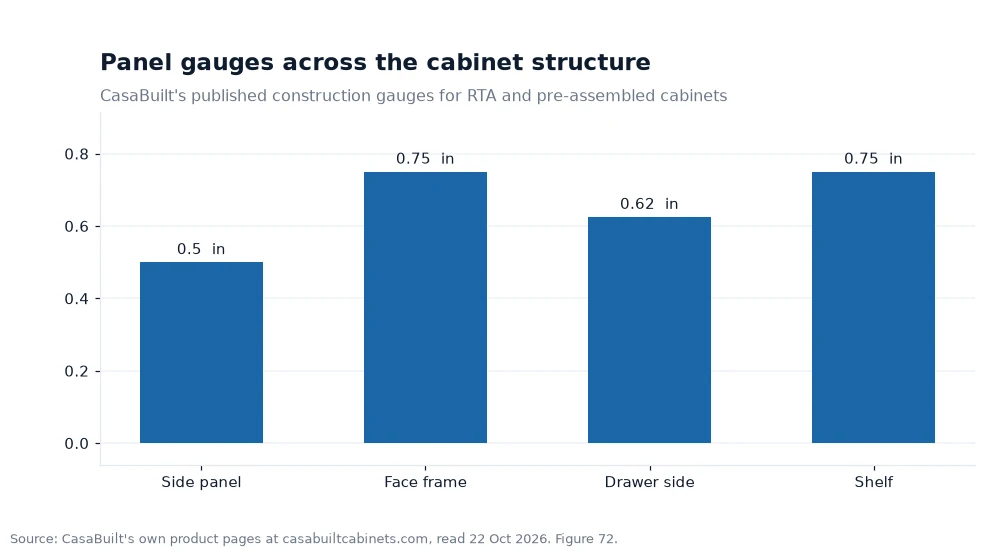
The published gauges are worth reading together, because they explain the hierarchy of the cabinet. The side panel is the thinnest structural sheet at 1/2 inch. The face frame and the shelf are both 3/4 inch. The drawer side sits between them at 5/8 inch. Each number is a decision about load, cost and weight rather than an accident of supply.
| Component | Gauge | Material | What the gauge does |
|---|---|---|---|
| Side panel | 1/2 in | Birch plywood | Closes the box and carries the shelf pins without bulging |
| Face frame | 3/4 in | Solid birch, 1-1/2 in wide | Takes the hinges and holds the front of the run straight |
| Drawer side | 5/8 in | Rubberwood, dovetail | Keeps the drawer square under a loaded pull |
| Shelf | 3/4 in | Plywood, adjustable | Spans the cabinet without a visible sag in the middle |
Notice where the thickness is concentrated. The two parts a hand touches, the face frame and the shelf, are the two 3/4-inch parts. The side panel, which is mostly hidden inside a run or against a wall, is thinner. That is not corner-cutting; it is the normal distribution of material in framed cabinetry, and it is the reason a cabinet can feel solid at the front and still be light enough to hang on a wall.
The shelf detail matters more than buyers expect. A 3/4-inch adjustable shelf with a half-depth shelf in the base cabinet is a different proposition from a fixed 1/2-inch shelf, because the pins let a household change the spacing when a taller stockpot arrives. The gauge is what stops the shelf bowing between the side panels once it is loaded.
Panel, rail and the finish that follows
The centre panel is the quiet part of the door and the part that shows the most wear. A flat panel collects light evenly, so any ripple in the substrate becomes visible at a low angle. MDF is chosen for that reason: it sands flat and stays flat, and it takes paint without telegraphing the grain pattern underneath. The rubberwood frame around it takes the knocks at the edge, where a solid timber is the better material.
The finish is listed as seven layers of paint with a UV protective coat. Seven coats is a slow process by cabinet standards, and the reason is flatness rather than colour depth: each coat fills a little more of the surface, and the final UV layer is what sits between the pigment and the light. A painted door in a south-facing kitchen is under ultraviolet load every afternoon, and the topcoat is the part designed to take it.
The hardware sits behind the door rather than on it. Hinges are soft-close, concealed and six-way adjustable, which means the door can be moved up, down, in, out and sideways after installation without redrilling. Drawers run on soft-close undermount glides with full extension, so the back of a deep drawer comes into view instead of stopping halfway. Those three adjustments are what make a frameless-style reveal line up across a run.
What the geometry costs
The published range puts the Shaker door at the accessible end and the slim oak-look door at the top. White Shaker's basic kitchen is $1,199.50 against a $2,399.00 list. Smokey Ash is $1,932.42 against $2,415.52. Both are five-piece doors; the difference is the finish and the frame width, not the construction method.
A buyer comparing shaker cabinets across those two lines should look at the frame first. A wide frame with a small panel reads traditional and hides a slightly uneven wall. A narrow frame with a large panel reads contemporary and shows every millimetre of misalignment in the run, which is why the six-way hinges matter more on the slim profiles than on the wide ones.
For contrast, the frameless collection removes the face frame entirely and relies on a full-overlay door against the box. That changes the reveal between doors, the way the hinges are mounted and the way the run terminates at a wall. It is a different look built to a different set of tolerances, and it is the right comparison for a buyer who likes the Shaker panel but wants a flatter front.
Worked example: reading the gauges
The chart gives four thicknesses: side panel 0.5 in, face frame 0.75 in, drawer side 0.625 in and shelf 0.75 in. Add them: 0.5 + 0.75 + 0.625 + 0.75 = 2.625 in across the four components. Compare them in pairs. The face frame is 0.75 / 0.5 = 1.5 times the side panel, so it is 50% thicker. The shelf and the face frame are equal at 0.75 in. The drawer side sits 0.625 - 0.5 = 0.125 in above the side panel, and 0.75 - 0.625 = 0.125 in below the shelf.
Put one gauge against a cabinet dimension. The base cabinet is 24 in deep, so a 0.75 in shelf is 0.75 / 24 = 3.125% of the depth. Small percentages, but they are the difference between a shelf that stays flat under a stack of plates and one that sags in the middle of a 36 in span. The 0.625 in drawer side is 0.125 in thicker than the box it slides inside, which is the material budget that lets a dovetail joint hold under load.
Frequently asked questions
Is a Shaker door solid wood?
The frame is rubberwood and the centre panel is MDF, which is the standard five-piece construction for a painted Shaker door. The cabinet box is 1/2-inch birch plywood with a 3/4-inch solid birch face frame. MDF is used for the panel because it sands flat and holds a painted plane without showing grain, while the solid frame takes the wear at the edges.
Why is the face frame thicker than the side panel?
The face frame is 3/4 inch and the side panel is 1/2 inch because the frame carries the hinges, the drawer hardware and the front edge of every shelf. The side panel only has to close the box and hold the shelf pins. Putting the extra material at the front is what keeps the door line straight across a run.
What does the seven-layer finish protect against?
The published finish is seven layers of paint with a UV protective coat. Each coat builds flatness, and the topcoat is the layer exposed to daylight, which matters most in a kitchen with a south or west window. The finish is covered by a one-year warranty against manufacturing defects in materials and workmanship under normal residential use.
Judge the door, then the box
Stand in front of a sample door and look along the frame edge for a straight shadow line. Then open a drawer and check that it runs the full depth of the cabinet on its glides. The profile is what sold the kitchen; the gauges are what keep it working in year five.
A buyer who understands the four numbers can compare two quotes without being distracted by the door style. Ask for the box material, the face frame thickness, the drawer side and the shelf, and the two quotes stop looking identical.
Figures quoted here come from the manufacturer's own website, read 22 Oct 2026[1].