Payback Math: Turning a Ranking Row Into Months
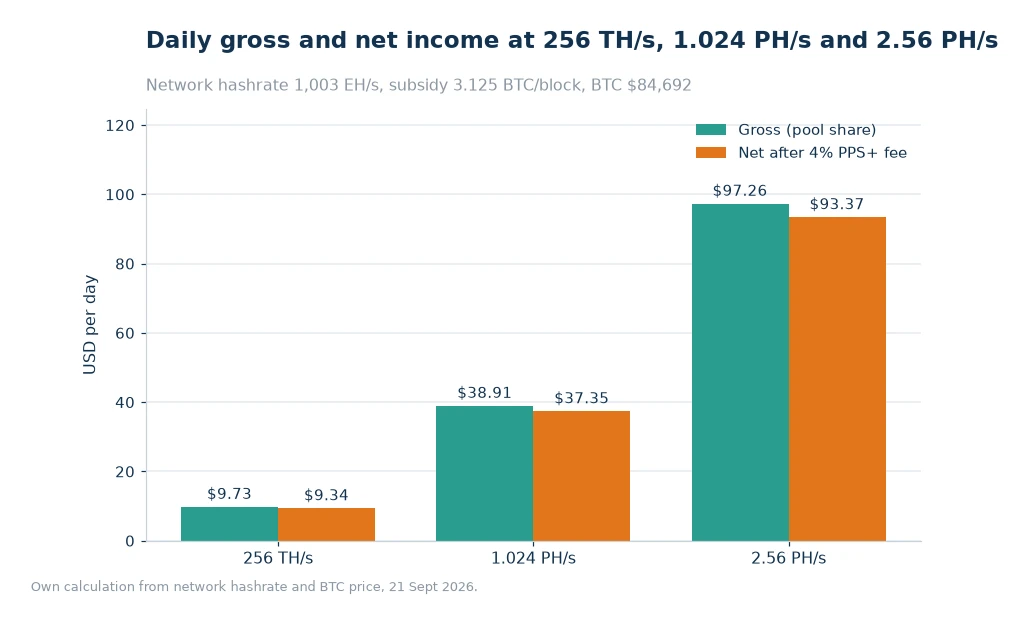
A ranking row gives revenue, and revenue is only half of a purchase decision. At 256 TH/s the pool credits 0.00011484 BTC a day, worth $9.73, and $9.34 after the listed 4% on the block-reward component. At 24 J/TH and $0.06 per kWh the power bill is $8.85, so the machine returns 49 cents a day against whatever it cost, and that last number is the one nobody publishes.

Key takeaways
- 256 TH/s credits 0.00011484 BTC a day, $9.73 gross and $9.34 after the listed 4% on the block-reward component.
- At 24 J/TH and $0.06 per kWh, power takes $8.85 of that, leaving $0.49 a day.
- Every $0.01 per kWh shifts the daily margin by $1.47 at this hashrate, which is three times the margin itself.
- Scaling to 1.024 PH/s or 2.56 PH/s multiplies both the margin and the capital, so payback in days does not improve.
The number a ranking leaves out
Profitability lists are built from coin price, difficulty and a model's nominal hashrate. Purchase price is not among the inputs, and neither is the cost of the power supply, the shelf, the network link or the electrician. That is not a flaw in the list; it is a boundary. The list answers what a machine earns, and payback answers what the machine is worth to own, which needs a second set of numbers.
The arithmetic is short. Take the daily credit after the listed rate, subtract the daily power cost, and the remainder is the daily return on the hardware. Divide the purchase price by that remainder and you have days to recover the capital, before any resale value and before any change in difficulty or price. If the remainder is small, the divisor is large, and small changes in either input move the answer by months.
Efficiency sets the denominator
Efficiency in joules per terahash decides how much of the credit the meter claims. Multiply by hashrate to get watts, multiply by 24 and divide by 1,000 for kilowatt-hours, then multiply by the tariff. At 256 TH/s and 24 J/TH that is 6,144 W, 147.5 kWh and $8.85 at $0.06. At 20 J/TH the same hashrate draws 5,120 W, uses 122.9 kWh and costs $7.37, which lifts the margin from 49 cents to $1.97 without touching the pool side at all.
That is why two machines with the same nominal hashrate can have paybacks that differ by years. The ranking orders them by revenue, and their revenue is identical. The difference lives in the third column of a spec sheet and in the tariff on the bill, and both are invisible in a sorted list of daily earnings.
Read the row, then price the box
The ViaBTC Miner Ranking is a reasonable place to find a model's nominal hashrate and efficiency, because both are listed beside the revenue figure. Copy those two numbers out, close the page, and finish the calculation somewhere that has your own tariff in it. A spreadsheet with four columns, hashrate, efficiency, tariff and price, will settle in an afternoon what a week of reading reviews will not.
Keep the terms honest while doing it. Power cost is not the only recurring item: cooling adds a fraction of the machine load, a failed fan or a PSU is a real annual cost, and downtime removes days from the numerator without removing any capital from the denominator. A payback figure that ignores those items is optimistic by a margin that is easy to estimate and rarely estimated.
One hashrate, four tariffs
The table fixes the machine at 256 TH/s and 24 J/TH and moves only the power price. The last column is the time needed to recover each $1,000 of hardware cost at that margin, which is a cleaner comparison than a payback figure tied to one asking price.
| Tariff per kWh | Power per day | Margin per day | Days per $1,000 |
|---|---|---|---|
| $0.04 | $5.90 | $3.44 | 291 |
| $0.05 | $7.37 | $1.97 | 508 |
| $0.06 | $8.85 | $0.49 | 2,030 |
| $0.07 | $10.32 | minus $0.98 | never |
A tariff difference of two cents takes the same machine from a 291-day recovery to a figure above five and a half years, and one more cent makes it a machine that costs money to run. No pool setting, firmware version or cable change produces that much movement. The power price is the single largest lever in the whole calculation, and it is usually fixed before the first machine arrives.
Two details about that price are worth pinning down before the table is trusted. The first is whether the quoted rate is the delivered rate, including transmission, taxes and any standing charge, because a headline figure below the real one flatters every row. The second is whether the rate changes by time of day or by season; a miner runs through the night and through the summer, so an average that assumes otherwise is not the average the machine will pay. Both details are questions for the utility rather than the pool, and both move the margin by more than a firmware upgrade ever will.
Worked example
Take the 256 TH/s row and build the payback from the network total upward.
- Per terahash: 450 BTC a day divided by 1,003,107,267,295 GH/s is 0.00000044861 BTC.
- 256 TH/s: 256 multiplied by 0.00000044861 is 0.00011484 BTC a day, or $9.73 at $84,692.
- Listed 4%: 0.00011484 multiplied by 0.96 is 0.00011025 BTC, or $9.34.
- Watts: 256 multiplied by 24 J/TH is 6,144 W, or 6.144 kW.
- Energy: 6.144 kW multiplied by 24 hours is 147.5 kWh.
- At $0.06: 147.5 multiplied by 0.06 is $8.85, and $9.34 minus $8.85 is $0.49.
- At $0.05: the bill is $7.37 and the margin is $1.97, so $1,000 takes 508 days.
- Four units at 1.024 PH/s: the margin is $1.96 and the capital is $4,000, so the ratio stays at about 2,030 days; ten units at 2.56 PH/s behave the same way.
What a two-year recovery requires
Work backwards from a target. Two years is 730 days, so a $2,000 machine needs a margin of $2.74 a day. At 256 TH/s and 24 J/TH the power budget is $9.34 minus $2.74, or $6.60 a day, which at 147.5 kWh means a tariff no higher than about $0.045 per kWh. If the local tariff is $0.06, the same target needs a machine at roughly 19 J/TH or a purchase price near $360.
Those are the trades a buyer actually faces: efficiency, tariff, price, and the length of time the machine is expected to stay competitive. Difficulty is the wild card. The next adjustment was estimated at minus 2.12% when the data was read, which would raise output per terahash by about 2%, but estimates move and the direction has reversed many times before.
Frequently asked questions
How long does a miner take to pay for itself?
It depends on the margin, not the revenue: at 256 TH/s with 24 J/TH and $0.06 per kWh the margin is $0.49 a day, so $1,000 of hardware takes about 2,030 days, while the same machine at $0.05 per kWh takes about 508 days.
Does a bigger machine pay back faster?
Only if it is more efficient or cheaper per terahash. Scaling 256 TH/s to 2.56 PH/s multiplies the credit and the power bill by ten, so the margin per dollar of hardware stays where it was.
Should time to payback include cooling and downtime?
Yes. Cooling adds a share of the machine load, downtime removes earning days without reducing the price paid, and both lengthen the recovery period, so a figure that leaves them out is the optimistic end of the range.
Price the box before the row
Revenue per day is a starting point, and a ranked list is a fast way to find candidate models. The decision itself needs the purchase price divided by the margin, and the margin needs your tariff and the machine's efficiency. Put those four numbers in one place and the answer stops moving around: the Profit Calculator supplies the credit, your bill supplies the cost, and the listed fee schedule tells you which rate applies before either figure is final.
Sources: the ViaBTC miner ranking page for nominal hashrate and efficiency figures and the fee page for the listed rates[1]. Chain inputs read 21 Sept 2026: network hashrate 1,003 EH/s, difficulty 132.76 T, subsidy 3.125 BTC per block, 144 blocks a day, BTC $84,692. Published 22 Oct 2026. Payback figures are arithmetic on the stated assumptions and are not a forecast of returns.